How Verification Works: The Technical Trust Behind Your Proof
Domain records, GitHub OAuth, revenue verification - here's exactly how ProofFabric confirms you own what you claim, without compromising your privacy.
"How do you actually verify this stuff?"
Fair question. If you're going to trust a platform to confirm your work, you deserve to know how it works under the hood.
Here's the honest breakdown of every verification method we use — what it proves, how it works, and what we never see.
The Verification Stack
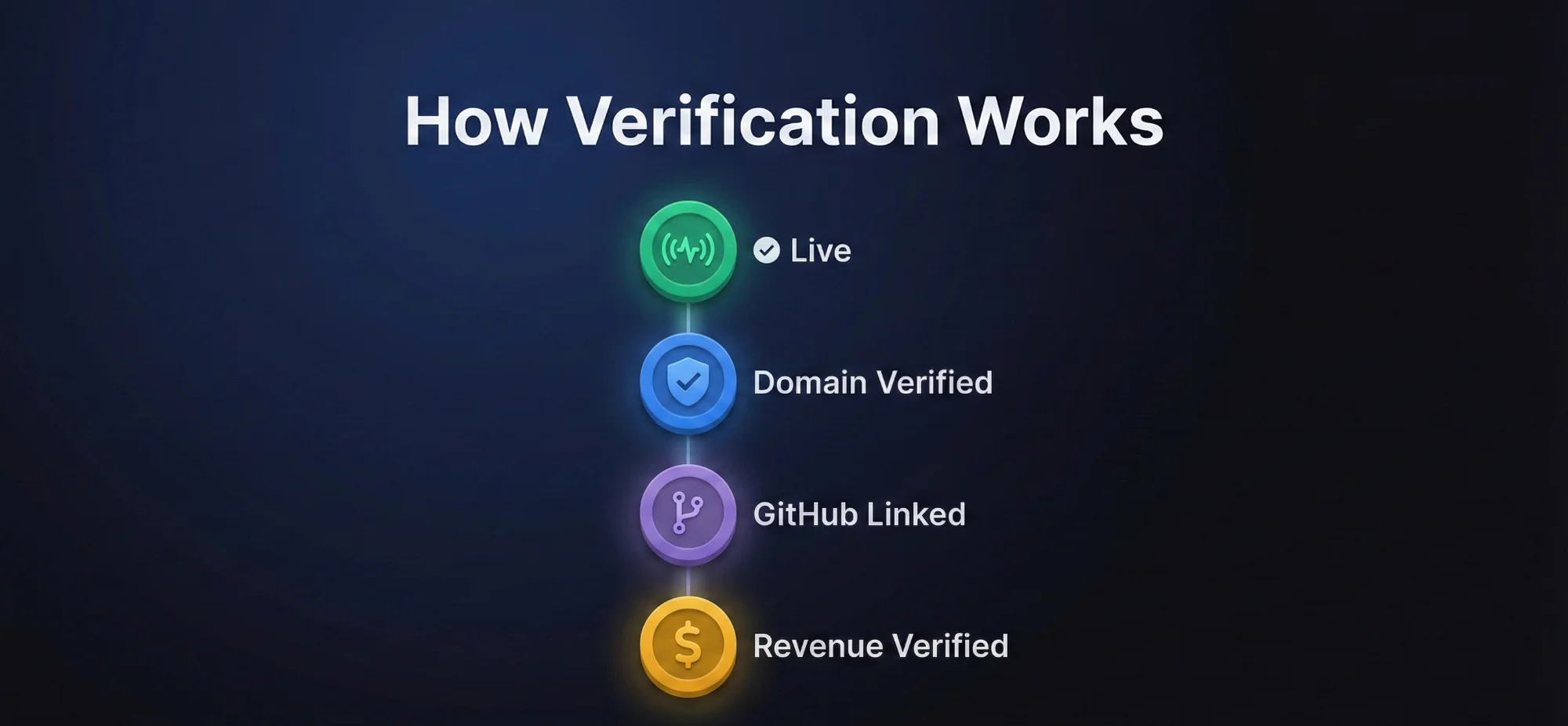
ProofFabric uses four verification levels, each proving something different:
| Verification | What It Proves | Trust Level |
|---|---|---|
| Live Check | The URL responds | Observed |
| Domain Ownership | You control the domain | Verified |
| GitHub Linked | You own or contribute to the repo | Verified |
| Revenue Range | The product makes money | Verified |
Let's break each one down.
1. Live Check (Observed)
What it proves: This thing exists and is accessible.
How it works:
- You enter a URL
- We ping it
- If it responds with a 200 status, you get the "Live" badge
What we see: Only that the URL responds. We don't track uptime, don't store response data, don't monitor it continuously.
Why it matters: It's the minimum bar. Anyone can claim they built something — this confirms it actually exists on the internet right now.
Trust level: Observed. We checked, it's there. But we haven't confirmed you own it yet.
2. Domain Ownership (Verified)
What it proves: You control this domain's DNS settings — which means you own it or have admin access.
How it works:
- We generate a unique verification code for you
- You add it as a TXT record to your domain's DNS
- You click "Verify"
- We query the DNS for that TXT record
- If it matches, you're verified
Example:
Record Type: TXT
Host: @
Value: prooffabric-verify=abc123xyz
What we see: Only the public DNS record. We don't access your registrar, don't see other DNS records, don't store credentials.
Why it matters: DNS access is the gold standard for domain ownership. You can't add a TXT record unless you control the domain. Period.
Trust level: Verified. This is cryptographic-level proof of ownership.
Time required: 2 minutes to add the record + up to 24 hours for DNS propagation (usually much faster).
3. GitHub Linked (Verified)
What it proves: Your GitHub account is connected, and you own or contribute to the repository.
How it works:
- You click "Connect GitHub"
- GitHub OAuth asks you to authorize ProofFabric
- You approve (read-only access)
- We check if your GitHub username matches the repo owner or contributors
- If yes, you're verified
What we request:
- Read access to your public profile
- Read access to your public repositories
What we never request:
- Write access to anything
- Access to private repos (unless you explicitly grant it)
- Your email or personal data beyond username
Why it matters: GitHub is the source of truth for code. If your account owns the repo or shows commits, you demonstrably built it.
Trust level: Verified. OAuth confirmation from GitHub itself.
4. Revenue Verification (Coming Soon)
What it proves: This product generates real revenue in a specific range.
How it will work:
- You connect your Stripe account via OAuth
- We query aggregate revenue data
- We assign a range (e.g., "$1k–$10k lifetime")
- You get the revenue badge
What we'll see: Only aggregate numbers needed to assign a range. We won't see individual transactions, customer data, or exact figures.
What we'll display: A range, not exact numbers. Your revenue stays private — we just confirm it's real.
Why it matters: Revenue is the ultimate proof of value. Someone paid for this. That's not fakeable.
Trust level: Verified. Direct confirmation from the payment processor.
Status: Coming soon. We're finalizing the Stripe integration.
What We Never Do
Let's be explicit about boundaries:
| We Never... | Why |
|---|---|
| Store your credentials | OAuth tokens are encrypted and scoped |
| Access private repos without permission | We request minimum scopes |
| See exact revenue numbers | Only ranges, for privacy |
| Write to your GitHub | Read-only access only |
| Track your sites continuously | One-time checks, not monitoring |
| Share verification data | Your proof is yours |
Your privacy isn't the cost of verification. It's a constraint we design around.
Why Not Just Screenshots?
You might wonder: why not just upload a screenshot of your Stripe dashboard or GitHub commits?
Because screenshots lie.
In 2026, anyone can generate a fake screenshot in seconds. AI makes it trivial. Screenshots prove nothing except that someone has Photoshop — or ChatGPT.
System-level verification is different:
- DNS records can't be faked without domain access
- GitHub OAuth comes directly from GitHub's servers
- Stripe OAuth comes directly from Stripe's API
We verify at the source, not the surface.
The Verification Hierarchy
Not every card needs every verification. Here's how to think about it:
Minimum viable proof:
- Live check ✓
Solid proof:
- Live check ✓
- Domain ownership ✓
Strong proof:
- Live check ✓
- Domain ownership ✓
- GitHub linked ✓
Undeniable proof:
- Live check ✓
- Domain ownership ✓
- GitHub linked ✓
- Revenue verified ✓
Each level adds trust. But even one verification puts you ahead of 90% of portfolios that are purely self-reported.
Common Questions
How long does verification take?
- Live check: Instant
- Domain: 2 min setup + DNS propagation (minutes to hours)
- GitHub: 30 seconds (OAuth flow)
- Revenue: 1 minute once available
Can I remove a verification? Yes. Disconnect anytime. The badge disappears immediately.
What if my DNS hasn't propagated? We'll tell you. Just wait and try again — usually resolves within an hour.
Do I need to verify everything? No. Add what you're comfortable with. More verification = more trust, but one verified signal is still valuable.
Is my data safe? We use encrypted OAuth tokens, don't store credentials, and follow security best practices. See our Privacy Policy for details.
Start Verifying
Verification isn't about bureaucracy. It's about making your work undeniable.
In a world where anyone can claim anything, verified proof is rare. And rare is valuable.
Ready to prove what you've built?