Verified vs Observed vs Stated: The Trust Ladder for Proof
In the new economy, proof isn't just what you claim — it's what can be trusted. Here's the simple trust ladder that makes your work undeniable.
In the old economy, credentials did most of the work.
A degree, a brand-name company, a title — those were shortcuts to trust.
In the new economy, trust has to be earned in the open.
Not with "trust me." With proof.
But not all proof is equal.
And the difference matters — especially when hiring managers, investors, clients, or collaborators have 30 seconds to decide if you're real.
So here's the simplest model we've found:
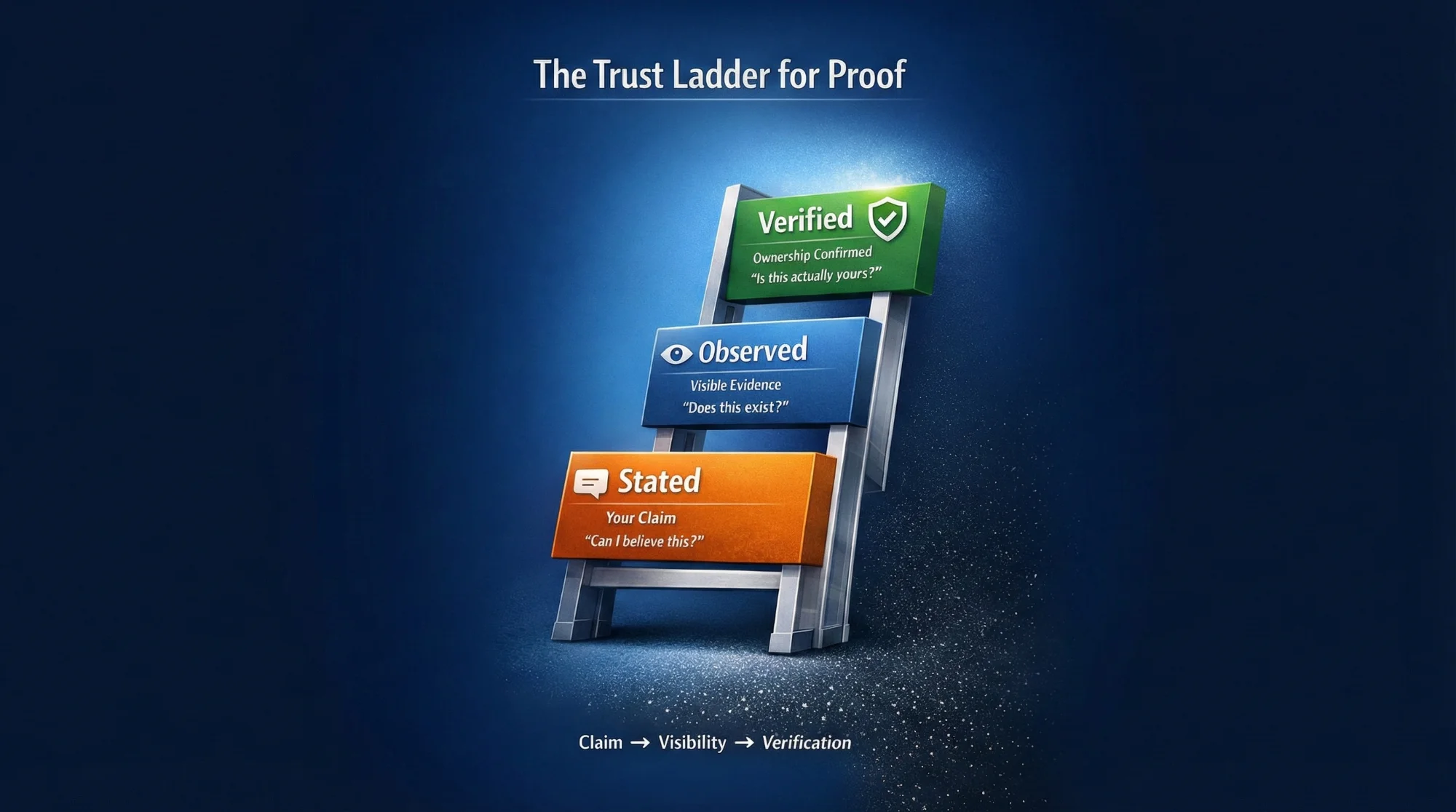
The Trust Ladder
Stated
Meaning: You're claiming something is true.
Example: "I built an AI workflow that saved the team 20 hours/week."
That might be true. It might be inflated. It might be a misunderstanding.
Stated proof isn't useless — it's often where your story starts.
But on its own, it's not defensible.
If your proof stack is mostly stated, you'll feel the friction:
- "Cool… do you have examples?"
- "Can you show me?"
- "How do I know that's real?"
Observed
Meaning: Someone can see something real exists.
Example: A live link to a product, demo, dashboard, app store listing, or public artifact.
Observed proof answers a different question:
"Does this thing actually exist?"
This is already a big step up.
But it still doesn't confirm ownership or authorship.
A link can be a team effort. A screenshot can be borrowed. A product can be copied.
Observed proof is visible — but not always verifiable.
Verified
Meaning: Ownership or authorship has been confirmed.
Example: Domain verification, GitHub verification, linked social identity, payment verification, or other signals that prove you're connected to the thing you're claiming.
Verified proof answers the question that matters most:
"Is this actually yours?"
Verification doesn't just add trust — it removes doubt.
When someone sees a Verified badge, they stop asking "is this real?" and start asking "how good is it?"
That shift is everything.
Why This Ladder Matters
Most people try to build proof like this:
- Stated claim
- One screenshot
- A link
- A vague bullet point
- Done
But in a world where AI can generate portfolios, landing pages, fake traction, and even entire products…
Proof has to climb the trust ladder.
Not because people are cynical — because they're overloaded.
The default now is: assume it's inflated until it's defensible.
What "Good" Looks Like in Practice
Here's what a strong proof stack looks like:
Example: "I built and shipped a product"
- Stated: "I built this product to solve X."
- Observed: "Here's the live link."
- Verified: "Domain verified + repo verified + identity linked."
Example: "I generated revenue"
- Stated: "This product makes money."
- Observed: "Here's the pricing + checkout flow."
- Verified: "Revenue range verified (without leaking exact numbers)."
Example: "I drove growth"
- Stated: "I grew signups 4x."
- Observed: "Here's the dashboard screenshot + public launch."
- Verified: "Source verified (analytics domain, verified account, or other signal)."
The pattern is the same:
Claim → Visibility → Verification
The Goal Isn't Perfection
You don't need everything verified.
In fact, insisting on total verification can backfire:
- you lose momentum,
- you over-document,
- you never ship.
Instead, aim for a defensible stack:
- Stated: your story and your thesis
- Observed: artifacts people can quickly inspect
- Verified: the handful of signals that remove doubt
That's how you earn trust fast.
The New Advantage: Trust Becomes a Moat
Here's the uncomfortable truth:
AI is making output cheaper.
Which means trust becomes more valuable.
In the new economy:
- code is abundant,
- content is abundant,
- "ideas" are abundant…
But verified proof is scarce.
And scarcity is where value lives.
Build Your Trust Ladder
If you want to pressure-test where you stand, start here:
- Take the assessment (2 minutes)
- Create a Proof Card
- Add 1–2 verification signals
- Share it anywhere you want to be taken seriously
Your work already speaks.
This is how you make it undeniable.